



The Ministry of Energy and Mineral Resources' Gadan Geological revealed that Mount Tangkuban Parahudi West Java experienced 130 low-frequency earthquakes (Low Frequency/LF) on July 1, 2025 to 24.00 WIB, which was the highest record for the past four days.
Head of the Geological Agency of the Ministry of Energy and Mineral Resources Muhammad Wafid revealed that on July 28, 2025, low-frequency earthquakes occurred 84 times, then rose on July 29 as many as 87 times, and jumped again on July 30, 2025.
"On July 30, a low-frequency earthquake was recorded to have occurred 90 times with an amplitude of 4-34 mm and an earthquake of 11-25 seconds," Wafid said as quoted by ANTARA, Wednesday, July 2.
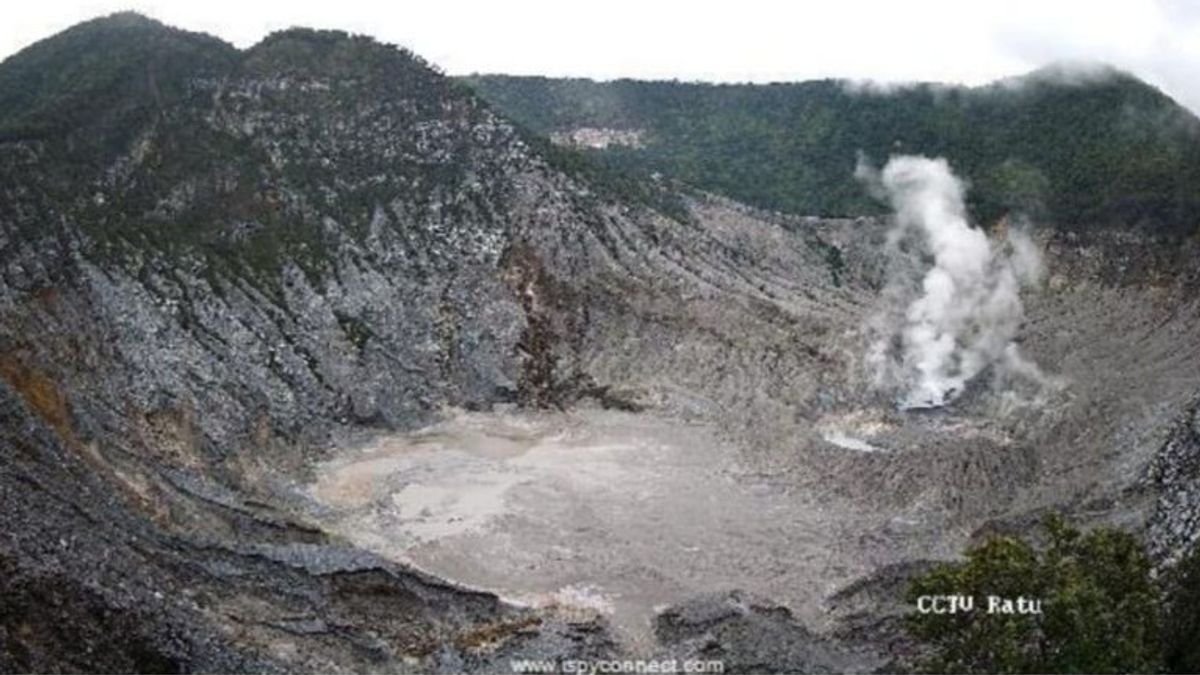
From seismic monitoring, he continued, to date, tremors are still dominated by tremors that are associated with mud boasting activities in Ratu Crater, where on July 1, 2025, in addition to 130 low-frequency earthquakes, there were also 11 gusts of earthquakes, and tremors with an amplitude of 0.5 1.5 mm (dominant 0.5 mm).
Observations of surface deformation by the GNSS and Tiltmeter methods, he said, did not show any significant deformation changes. Meanwhile, EDM monitoring data still shows a tendency for inflationary patterns, indicating an accumulation of pressure on the shallow depth below the volcano's body.
From visual monitoring, Wafid continued Mount Tangkuban Parahu experienced gusts of thin to moderate white smoke with heights ranging from 20 to 130 meters from the bottom of the Queen Crater and 5 to 10 meters from the bottom of the Ecoma Crater, with weak to moderate pressure.
The manifestation of mud talk in the Ratu Crater which was formed on June 5, 2025 until now is still being observed, with the level of intensity of boasting decreasing while the area of boasting mud is still the same.
"This needs to be a concern because the potential for phreatic eruptions can still occur suddenly, without being preceded by clear volcanic symptoms," said Wafid.
SEE ALSO:



Wafid said that until July 1, 2025, gas measurement data from the permanent Multi-GAS station had not shown any significant changes to the gas ratio (CO2/SO2, CO2/H2S, H2O/CO2, H2S/SO2) as well as the proportions between SO2 and H2S gas.
"By considering all the data above, the level of activity of Mount Tangkuban Parahu is still at Level I (Normal)," he said.
People around Mount Tangkuban Parahu and visitors, he said, are still advised not to approach the bottom area of the crater, not to linger in the active crater area, and to immediately move away if there is an increase in the intensity of gusts or the smell of strong gas.
Local governments and BPBDs are also asked to continue to coordinate with the Tangkuban Parahu Volcano Observation Post in Cikole Village and the Center for Volcanology and Geological Disaster Mitigation (PVMBG) in Bandung.
The public is expected to remain calm, not easily influenced by issues that cannot be accounted for, and to follow the development of official information.
"The evaluation of the activity level of Mount Tangkuban Parahu will be carried out regularly or at any time if there is a significant change. The community is expected to remain calm, alert, and follow directions from the authorities for the sake of mutual safety," he said.
Mount Tangkuban Parahu is an active volcano located in the West Bandung Regency and Subang Regency, West Java Province. This volcano has 9 craters with two main craters in the top area, namely the Ratu Crater and Upas Crater.
The eruption of Mount Tangkuban Parahu is generally a phreatic eruption from the Queen Crater.
The English, Chinese, Japanese, Arabic, and French versions are automatically generated by the AI. So there may still be inaccuracies in translating, please always see Indonesian as our main language. (system supported by DigitalSiber.id)


