
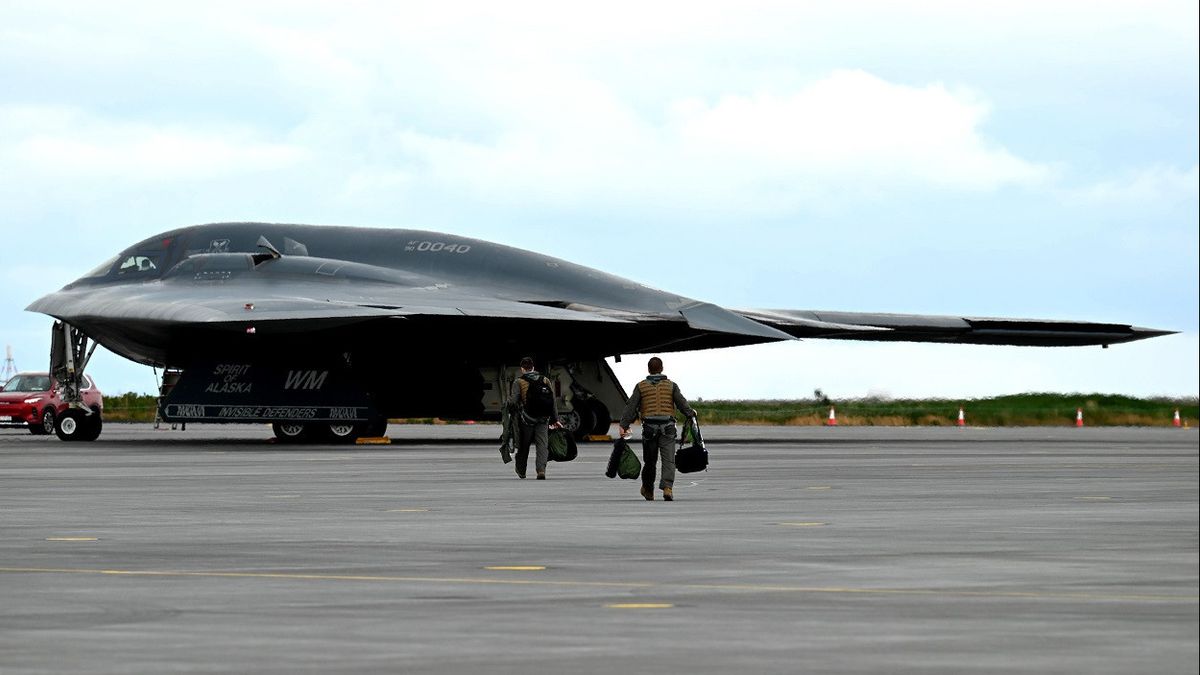


JAKARTA - There are long preparations that must be made before the operation of the US B-2 Spirit stealth bomber, especially the pilots who manned it, due to the distance and range of time in long-distance operations carried out by the aircraft.
The B-2 Spirit stealth bombers were deployed to attack three Iranian nuclear facilities Natanz, Fordow, and Isfahan on June 21.
The chairman of the US Joint Chiefs of Staff, General Dan Karyare, confirmed that the "Midnight Hammaer" operation covered flights for 18 hours each way after taking off from the Whiteman Air Base in Misouri USA across the Atlantic Ocean, several times refueling in the air, to fanfare flights, as quoted by the BBC on June 25.
General Karyare said the main attack was carried out by seven B-2 Spirit bombers, each manned by two.
The operation of the aircraft demands tremendous resilience from its two crew members, with weeks of preparation ranging from flight plans to what is eaten, based on the veteran pilot experience he has manned.
It started by understanding how nutrition affects vigilance and digestion during intercontinental flights that can last almost two full days.
"We went through a sleep study, we really underwent nutrition education to be able to teach each of us: first, what woke us up and then what helped us sleep," said retired Lieutenant General Steve Basham, who flew B-2 for nine years and retired in 2024 as Deputy Commander of US European Command.
Pilots are trained to recognize food and how it slows down or accelerates digestion, which is very important on an airplane with one chemical toilet. Basham's flagship diet, turkey sandwich with whole wheat bread, without cheese.
"As soft as possible," he said.
With a wingspan of 172 feet (52.4 m) and stealth capabilities, B-2 can fly as far as 6,000 nautical miles without refueling, but most missions require several refills of fuel in the air. The process becomes even more difficult when fatigue begins to feel.
At the time of refueling, pilots cannot see an elongated boom from a tanker filled with gas attached to a 16-foot B-2 behind their head. Instead, they rely on visual signals from the tanker lights and the reference points that are memorized. At night, especially on moonless flights, the task becomes what Basham calls "very dangerous."
"Adrenalin makes you continue to advance before entering remote areas," he said.
"The drainage is gone. You try to rest for a while and you still have one last refueling", he explained.
The B-2 cockpit has a small area behind the chair, where the pilot can lie on the pan. Sunflower seeds help some people stay alert between meals.
Although the design is up-to-date - a feature that makes it hidden can reduce infrared, radar and acoustic signatures - B-2's success depends on human performance.
Two crew members replaced the larger teams needed for older bombers such as B-1B and B-52, placing more responsibility on each crew member.
The B-2 fly-by-wire system, which relies entirely on computer input, has grown since its 1989 debut. The initial software lags behind the pilot's orders, making refueling difficult, Basham said.
Updates have increased responses, but the challenge of flying in meeting formations at high altitude remains.
During the Allied Force Operation in 1999, B-2 flew back and forth for 31 hours from Missouri to Kosovo, attacking 33 percent of the target in the first eight weeks, according to the Air Force.
While in Iraq, the plane dropped more than 1.5 million pounds of ammunition in 49 sudden attacks.
SEE ALSO:
The US Air Force plans to replace its B-2 and B-1 fleets with at least 100 B-21 Raiders over the coming decades. The cost of operating B-2 is around $65,000 per hour, compared to $ 60,000 for B-1, according to Pentagon data.
"Our plot makes it look easy, but it's actually far from easy," Basham said.
A complicated B-2 mission cannot be done "without a large series of planners in the field around the world and maintenance workers who make sure you always have a good plane."
The English, Chinese, Japanese, Arabic, and French versions are automatically generated by the AI. So there may still be inaccuracies in translating, please always see Indonesian as our main language. (system supported by DigitalSiber.id)
Most Popular Tags
#Prabowo Subianto #donald trump #2026 World Cup #venezuela #konflik timur tengahPopular


