

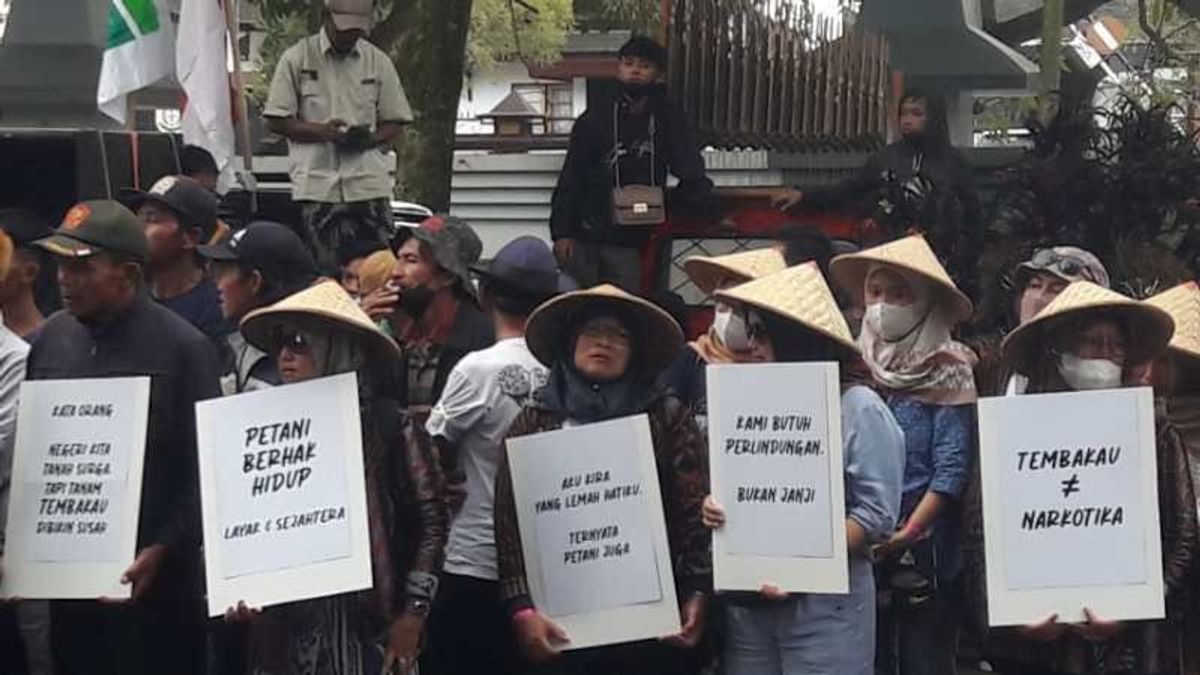


JAKARTA - Member of Commission IX DPR RI Nurhadi highlighted the Ministry of Health (Kemenkes) which will issue a policy for cigarette packaging in the Draft Regulation of the Minister of Health (RPMK), as a derivative rule of Government Regulation (PP) Number 28 of 2024. The policy regulates zoning and advertising of tobacco products, especially packaging designs so that they are plain and uniform.
Nurhadi questioned the sustainability of the RPMK which at the meeting with Commission IX of the DPR, Minister of Health Budi Gunadi Sadikin had not clearly explained the purpose of implementing the regulation.
Nurhadi also admitted that he was worried that the RPMK which regulates restrictions on advertising and controlling tobacco products would harm cities whose economies depend heavily on this industry, such as Bondowoso and Kediri.
"I encourage the government to re-evaluate and involve more parties before the RPMK is ratified," said Nurhadi, Monday, June 9.
Previously, the Head of Communication & Public Service of the Indonesian Ministry of Health, Siti Nadia Tarmizi, explained that the purpose of this RPMK was to control cigarettes and other addictive substances. The Ministry of Health stated that it does not prohibit people from smoking, because smoking is the right of everyone.
However, the plan to compile the RPMK actually caused various polemics. In fact, many think that this rule can have a bad impact, both on the national economy and on the health side.
This rule is also considered to provide great opportunities for the sale of illegal cigarette products so that it is counterproductive to the government's goal of reducing the prevalence of smokers.
"So I really feel that the Minister is smart but not wise. I am analogizing the RPMK policy, such as the driver in front of him, there is a buffalo who wants to cross. If you keep going, the driver will crash the buffalo, maybe the buffalo will die, the car will be damaged and the driver will be injured, but if you hold back a little the desire to keep going, then everything will be safe," said Nurhadi.
Because it will also have an impact on the economy, Nurhadi assessed that the Ministry of Health needs to take a deeper look at the tobacco industry's RPMK. According to him, the policy does not show partiality to farmers and tobacco business actors.
The three points that are the focus of the policy are the application of plain packaging to cigarettes, the prohibition of selling cigarettes at a radius of 200 meters at educational centers and playgrounds as well as a ban on advertising cigarette products. These three points are also still controversial, so further studies are needed.
"We have to study more deeply regarding the plan for the three points that will be implemented. If the scenario is implemented, the economic impact that will be lost is equivalent to Rp308 trillion or 1.5 percent of GDP," explained the legislator from the East Java VI electoral district.
In addition, Nurhadi continued, this policy could also affect the achievement of the economic growth target of more than 5 percent. If it continues to be implemented, he said, the government risks losing tax revenues of IDR 160.6 trillion or 7 percent of the total national tax revenue.
"So I ask again, why does the Ministry of Health force this PMK to run so much? In fact, the implementation of this rule will fertilize the circulation of illegal cigarettes by encouraging excessive policies," said Nurhadi.
On the other hand, Nurhadi also questioned the plan to provide compensation or alternative programs for retail farmers and traders who will be affected by this RPMK. He also regretted that there was no involvement of community organizations such as the Tobacco Farmers Union which could provide other perspectives on the plan to implement the policy.
"It's not that I'm fussy, I don't smoke, but I empathize with 1,300 cigarette industries with 600,000 employees. Hundreds of thousands of tobacco farmers and tens of thousands of small traders who depend on this industry's life will be affected," said Nurhadi.
"This policy is indeed to create a healthy society, but not to turn a blind eye to the existence of these thousands of tobacco industries. Where in fact there are hundreds of thousands of people who depend on their lives here," he continued.
SEE ALSO:

Therefore, Nurhadi appealed to the Ministry of Health to find a wiser solution in overcoming this problem. He emphasized that every policy taken by the government must also prioritize people's lives.
Nurhadi stated that his party would oversee the implementation of the RPMK. He reminded that the discussion of the RPMK had never involved the Ministry of Manpower, so there was a interpretation between the Ministry of Health and the Ministry of Manpower not the same.
"And if this RPMK is implemented, it will not be much different from our brothers and sisters, dairy farmers, where every day there are hundreds of tons of dairy cows that are thrown away and sacrificed," said the member of the DPR from the NasDem faction.
"So it's really funny that this country if every policy has to wait for an evaluation after the commotion occurs. And it must be underlined, I strongly reject this RPMK not because I am a smoker, no, but purely because I personally see the negative effect of the RPMK implementation later," concluded Nurhadi.
The English, Chinese, Japanese, Arabic, and French versions are automatically generated by the AI. So there may still be inaccuracies in translating, please always see Indonesian as our main language. (system supported by DigitalSiber.id)


