

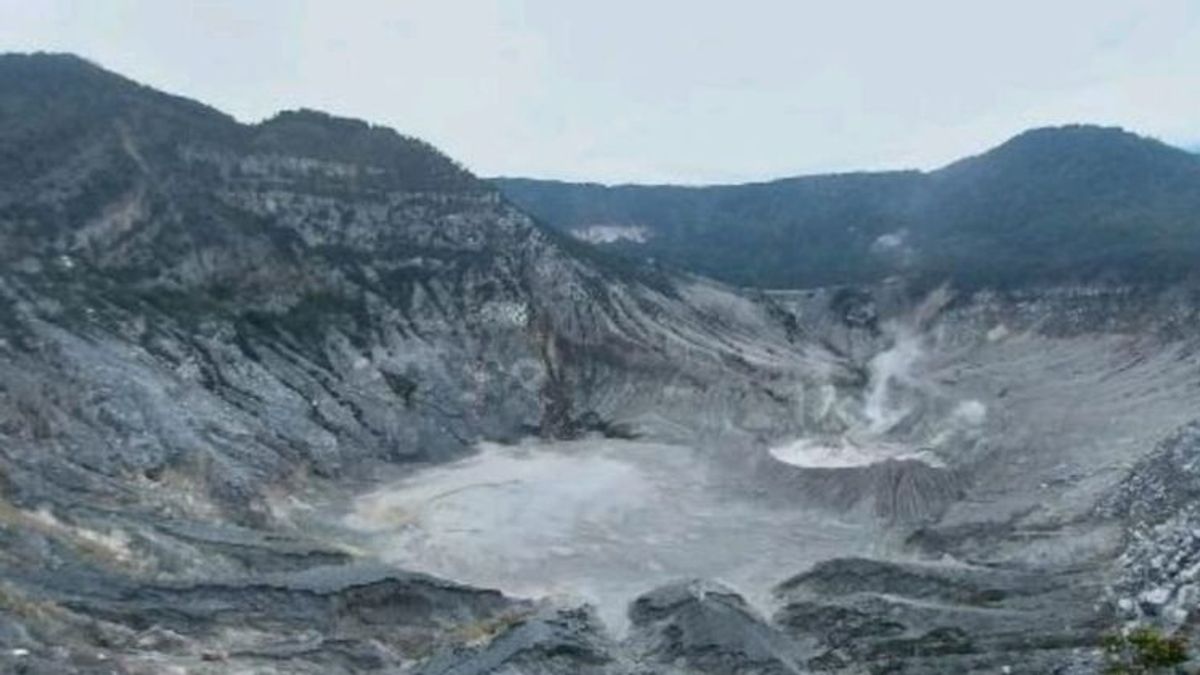


Mount Tangkuban Parahu on the border of West Bandung and Subang Regencies, is still experiencing an increase in activity in the form of earthquake gusts between 21-37 events and low-frequency earthquakes reaching 134 events.
Head of the Geological Agency of the Ministry of Energy and Mineral Resources, Muhamad Wafid, said the data was obtained from seismic recordings from May 30 to June 2, 2025, with the results of monitoring deformations through the Electronic Distance Measurement (EDM) and Global Navigation Satellite System (GNSS) methods also showing inflation patterns or an increase in pressure on the mountain body.
Wafid explained that with the current rainfall around Tangkuban Parahu which is high, plus the nature of this mountain with low-frequency earthquakes, it is possible that there will be a hot magma bridge through the rock or volcanic material that makes the body of a volcano, and will heat up the groundwater system in the volcanic body.
"In these conditions, water can experience extreme (superheating) heating, produce steam with very high pressure, and finally there is a phreatic eruption," Wafid said as quoted by ANTARA, Tuesday, June 3.
This low frequency earthquake indicates fluid movement activity at shallow or near the surface and its increase is correlated with an increase in the intensity of gas gusts that can occur due to changes in pressure (accumulation) at shallow depths. However, indications of accumulated pressure from inner magma have not been observed.
"However, until now the level of volcanic activity of Mount Tangkuban Parahu is still at Level I (Normal), marked by smoke gusts from the Queen Crater with thin to thick intensity, with a height of 5-120 m above the bottom of the crater," he said.
Although normal, the Geological Agency warns that there is a potential hazard in the form of a phreatic eruption, which occurs without any significant increase in volcanic symptoms, and if this happens, it can be accompanied by ash rain and ejection of material around the crater.
Thus, the community and visitors of Tangkuban Parahiudi asked not to approach the bottom of the crater, not to linger and not to stay in the active crater area there.
Then, immediately leave the area around the crater if an increase in the intensity/thickness of the crater smoke is observed and/or if the gas smells pungent in order to avoid potential hazards of exposure to toxic gas or phreatic eruptions.
"The community around Tangkuban Parahu is expected to remain calm and active as usual. Do not be provoked by issues regarding the eruption, and always follow developments and directions related to mountain activity from official sources," he said.
Evaluation of the activity level of Mount Tangkuban Parahu, said Wafid, will be carried out periodically or at any time if there is a significant change.
SEE ALSO:



Regional governments, provincial and district BPBDs are also expected to always coordinate with the Tangkuban Parahu Volcano Observation Post in Cikole Village, Lembang District, West Bandung Regency or the Center for Volcanology and Geological Disaster Mitigation in Bandung to anticipate all possibilities.
Tangkuban Parahu has nine craters, with the main two in the top area, namely the Upas Crater and Ratu Crater which are often the origin of the phreatic eruption.
The English, Chinese, Japanese, Arabic, and French versions are automatically generated by the AI. So there may still be inaccuracies in translating, please always see Indonesian as our main language. (system supported by DigitalSiber.id)


