

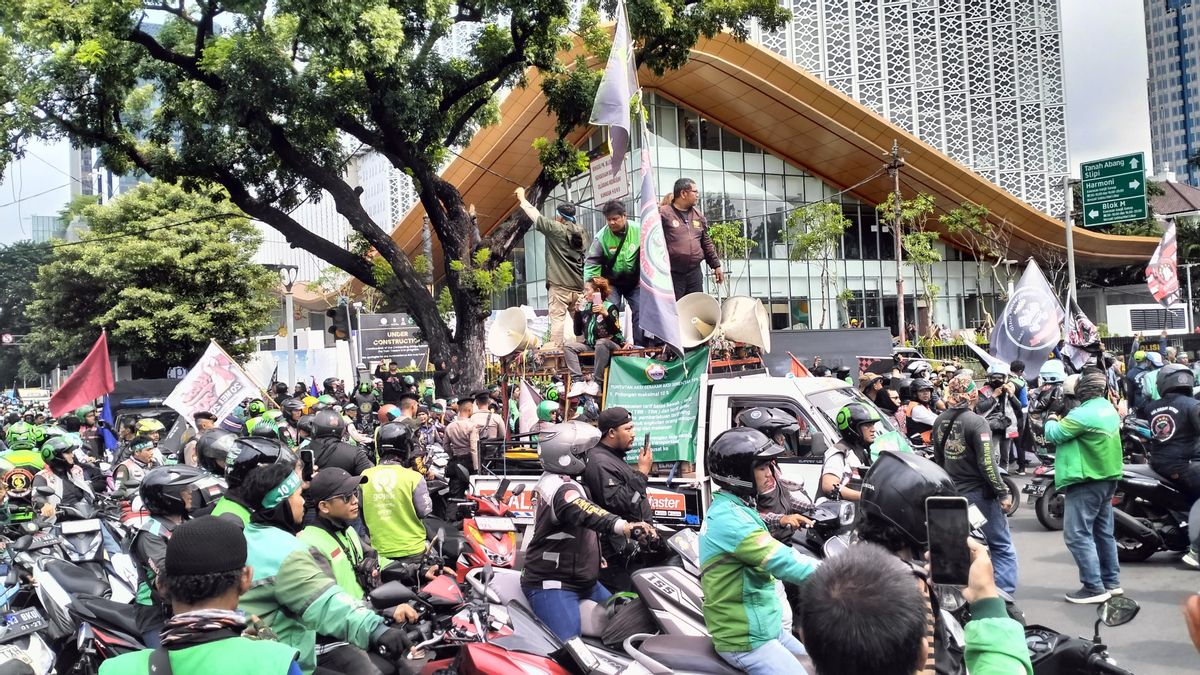


JAKARTA - The Association for Digital Indonesia Mobility and Introductory (Modantara) responded to a demonstration by a number of online motorcycle taxi drivers and digital couriers in Jakarta and a number of areas.
Modantara Executive Director Agung Yudha assessed that this action was indeed the right to freedom of expression. However, policies for millions of driver-partners and service users must be prepared based on data and economic reality, not merely political impetus.
"We understand partner unrest, but the solution must be based on economic reality, not just a political discourse. This ecosystem has proven to be a social cushion during a crisis. Therefore, the policies governing it must rely on data and consider the long-term impact," Agung said in his statement, Wednesday, May 21.
Against the demands of a single commission of 10 percent on all ojol applicator platforms, Agung considered this not in accordance with the dynamics of the industry. This is because applicators have various business models, based on services, markets, and different partner empowerment strategies.
"According to Agung, the uniformity of commissions can actually hinder innovation, threaten services in areas with low margins, and force excessive efficiency that has an impact on the quality of service to consumers," he said.
Meanwhile, the desire of ojol people to become permanent employees, according to Agung, has the potential to have a major impact on employment and the national economy.
Based on a study by the Svara Institute (2023), this change in status has the potential to remove 70 to 90 percent of jobs in this sector, and cause a decline in Indonesia's Gross Domestic Product (GDP) by 5.5 percent or around Rp178 trillion.
"Several countries such as Spain, Switzerland, and the UK have experienced similar impacts after implementing similar policies, including an increase in service rates of up to 30 percent, a decrease in the number of active partners, and the departure of a number of platforms from the market," explained Agung.
SEE ALSO:


SEE ALSO:
Furthermore, regarding the demand for tariff adjustments, Agung supports efforts to improve partner welfare but rejects a uniform approach that does not take field conditions into account. Consumer purchasing power, operational costs, and variety of service areas must be the main consideration.
"We have to pay attention to the operational costs and living standards of partners, but tariffs that are too high will reduce consumer interest, it's useless for high tariffs but there are no buyers," he said.
.
Agung predicts that if all ojol demands are met by applicators, it could risk limiting the recruitment of new partners, increasing service prices, and encouraging platforms to leave non-commercial areas.
As an alternative, Modantara encourages collaborative incentives and social protection-based approaches, such as MSME financing schemes, parking and tax incentives, as well as entrepreneurship training.
"The way ODS works, speed, and delivery functions with conventional logistics are very different, uniforming tariffs will limit innovation and slowly killing industries," he said.
The English, Chinese, Japanese, Arabic, and French versions are automatically generated by the AI. So there may still be inaccuracies in translating, please always see Indonesian as our main language. (system supported by DigitalSiber.id)
Most Popular Tags
#Prabowo Subianto #donald trump #2026 World Cup #Febrie Adriansyah #8791Popular


