

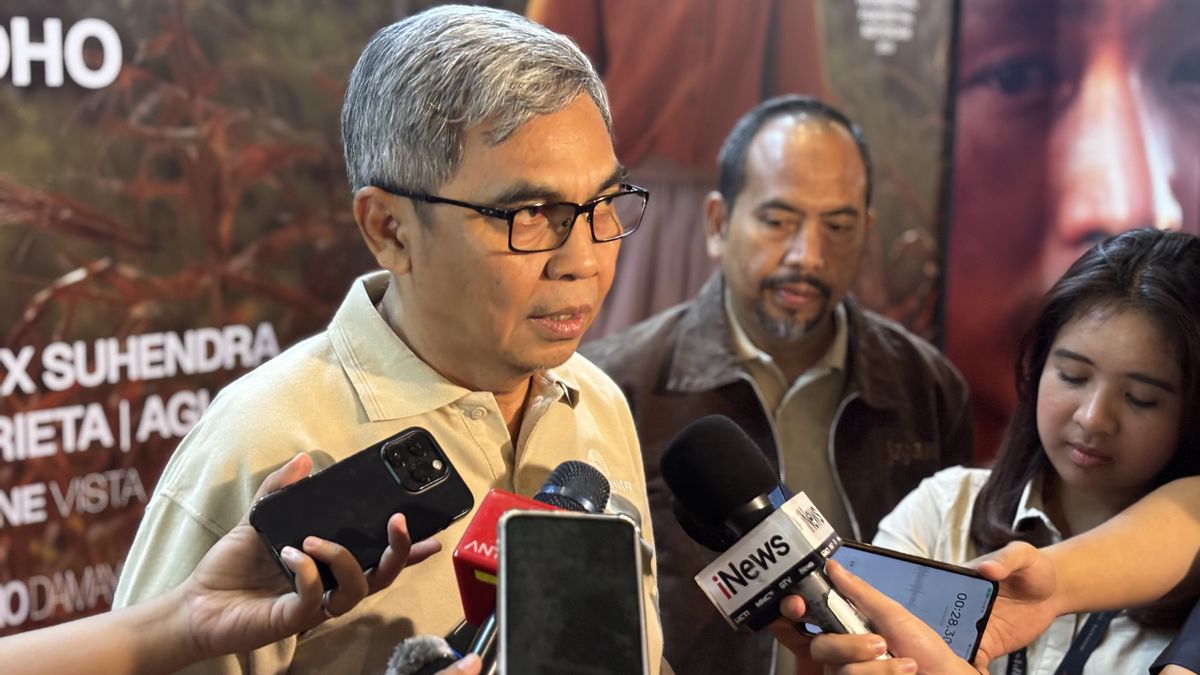


JAKARTA - Chairman of the Corruption Eradication Commission (KPK) Setyo Budiyanto invites if any party file a lawsuit to the Constitutional Court (MK) regarding the BUMN Law. Every citizen is said to have rights.
Reporting from a number of reports, the BUMN Law was sued by the Constitutional Court (MK) by two students of the Faculty of Law, University of Indonesia. The preliminary hearing was held on Thursday, May 8.
The petitioners asked the Constitutional Court to declare Law Number 1 of 2025 concerning SOEs does not comply with the provisions for the formation of legislation as mandated by the 1945 Constitution. This is because the principle of openness is ignored in the discussion process.
This regulation was also asked to be declared contrary to the 1945 Constitution.
"Yes, it's a process. I think it's a process, go ahead of me, yes," Setyo told reporters in the Grand Indonesia Mall area, Central Jakarta, Friday, May 9.
"I think if the judicial review lawsuit process in the Constitutional Court, what all kinds of things is the right of citizens to submit. We'll see, what the results will be (lawsuit, ed) to the Constitutional Court," he continued.
Meanwhile, KPK Spokesperson Budi Prasetyo emphasized that the KPK would still investigate allegations of corruption in BUMN if there was strong evidence. This attitude is taken from a study carried out by the legal bureau team.
One of these studies, continued Budi, was related to the status of directors/dewan commissioners/dewan supervisors of SOEs who were no longer state administrators based on Article 9G of Law 1 of 2025. "KPK sees a contradiction," he said.
Budi explained that this contradiction arose if this regulation was juxtaposed with Law Number 28 of 1999 regarding State Administrators Free from Corruption, Collusion, and Nepotism.
"KPK considers that Law Number 28 of 1999 is an administrative law that specifically regulates state administrators with the aim of suppressing corruption, collusion and nepotism," he said.
"So, we firmly rely on Law Number 28 of 1999 in seeing the status of directors, commissioners, and supervisory boards in SOEs as state administrators," continued Budi.
SEE ALSO:



Previously reported, the government previously ratified Law Number 1 of 2025 concerning the Third Amendment to Law Number 19 of 2003 concerning SOEs. In that regulation, Article 9G states that the Board of Commissioners, and Supervisory Board of SOEs are not state administrators.
Meanwhile, Article 9 F of the BUMN Law states that the Board of Directors, Board of Commissioners, and Supervisory Board cannot be held legally accountable for losses if they can prove it.
The English, Chinese, Japanese, Arabic, and French versions are automatically generated by the AI. So there may still be inaccuracies in translating, please always see Indonesian as our main language. (system supported by DigitalSiber.id)


