

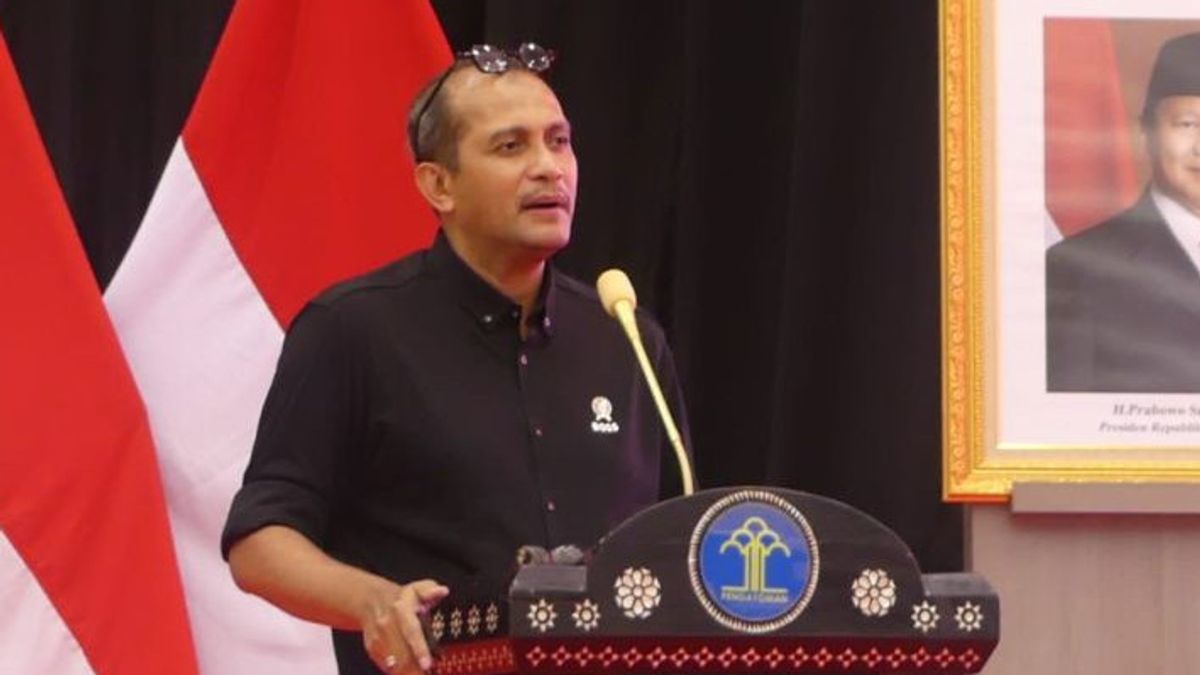


Deputy Minister of Law (Wamenkum) Edward Hiariej admitted that he did not agree with the concept of the Commissioner Judge or Preemptive Examining Judge in the Draft Law (RUU) of the Criminal Procedure Code (KUHAP).
The concept is proposed to replace the pretrial system in the process of investigating and prosecuting criminal cases.
"The burden of cases is too much for judges and the geographical situation of Indonesia, which consists of various islands, with a strict period of time, making it difficult for Indonesia to implement the practice of the Commissioner Judge," said the man who is familiarly called Eddy, in the National Seminar for Renewal of the National Criminal Code and the Urgency for Renewal of the Criminal Procedure Code, which was monitored online in Jakarta, Friday, February 21.
Nevertheless, he agreed regarding several things on the concept of the Commissioner Judge or Judge of Preamble Examination in the Criminal Procedure Code, namely one of which is the Indonesian pretrial system which must be expanded and strengthened.
However, he said, the criminal procedural law aims to prevent arbitrary power from law enforcement officers, not to process a suspect.
Therefore, Eddy emphasized that pretrial must be expanded so that all forced efforts can be requested for pretrial, both the determination of suspects, search, confiscation, and examination of letters.
Thus, the pretrial system is not only limited to the issue of arrest, detention, whether or not the termination of the investigation is legal or not the termination of prosecution and rehabilitation, as well as compensation.
In addition, he said, another thing that must be strengthened in the Indonesian justice system is how to obtain evidence, because in the framework of due process of law or fair legal process, which is currently adopted by the Criminal Code (KUHP), there is a term unlawful legal evidence or illegal legal evidence.
Therefore, he said that the Criminal Procedure Code Bill must also harmonize the DU process of law framework.
"That the acquisition of evidence with an illegal road should not be taken into account as evidence in the examination of the case," he said.
SEE ALSO:
-
 | BERITA
Mahfud MD Kritisi RUU Kejaksaan: Pemeriksaan Jaksa Bersalah Enggak Harus Izin Jaksa Agung
20 Februari 2025, 14:35 -
 | BERITA
Serah Terima Jabatan Gubernur-DKI, Teguh Setyabudi Tak Ragukan Rekam Jejak Pramono-Rano
20 Februari 2025, 13:59 -
 | BERITA
Usai Dilantik di Istana, Ahmad Luthfi Akui Bakal Benahi Jalur Pemudik Melintas Jateng
20 Februari 2025, 13:33 -
 | BERITA
Diskusi KTT Liga Arab Bangun Gaza Tanpa Usir Warga Palestina Diundur Jadi 4 Maret
19 Februari 2025, 16:28

The Plenary Meeting of the 13th Indonesian House of Representatives (DPR) Session Period II of the 2024-2025 Session Year at the Parliament Complex, Jakarta, Tuesday (18/2), has approved the Bill on Amendments to Law Number 8 of 1981 concerning the Criminal Procedure Law or the Criminal Procedure Code as a bill proposed by the initiative of the DPR RI.
The approval was made after all political party factions in the DPR RI expressed their views in writing regarding the Criminal Procedure Code as a bill proposed by the DPR RI initiative by their respective faction spokesmans.
Since entering the trial period after the initial recess in 2025, Commission III of the DPR RI has started to discuss the Criminal Procedure Code Bill by inviting various sources, including the Judicial Commission and the Supreme Court.
The Criminal Procedure Code Bill is also included in the 2025 Priority National Legislation Program (Prolegnas) proposed by Commission III of the DPR RI. Commission III of the DPR RI stated that the Criminal Procedure Code Bill should be immediately discussed because the new Criminal Code Law will take effect on January 2, 2026.
In addition, the ratification of the Criminal Procedure Code is considered important because the Criminal Procedure Code is a formal law that operates the implementation of the Criminal Code as a material law. For this reason, the spirit of law politics of the Criminal Procedure Code must be the same as the spirit of legal politics contained in the Criminal Code.
The English, Chinese, Japanese, Arabic, and French versions are automatically generated by the AI. So there may still be inaccuracies in translating, please always see Indonesian as our main language. (system supported by DigitalSiber.id)
Popular


